
Study 16 · Strange Attractors
Aizawa System
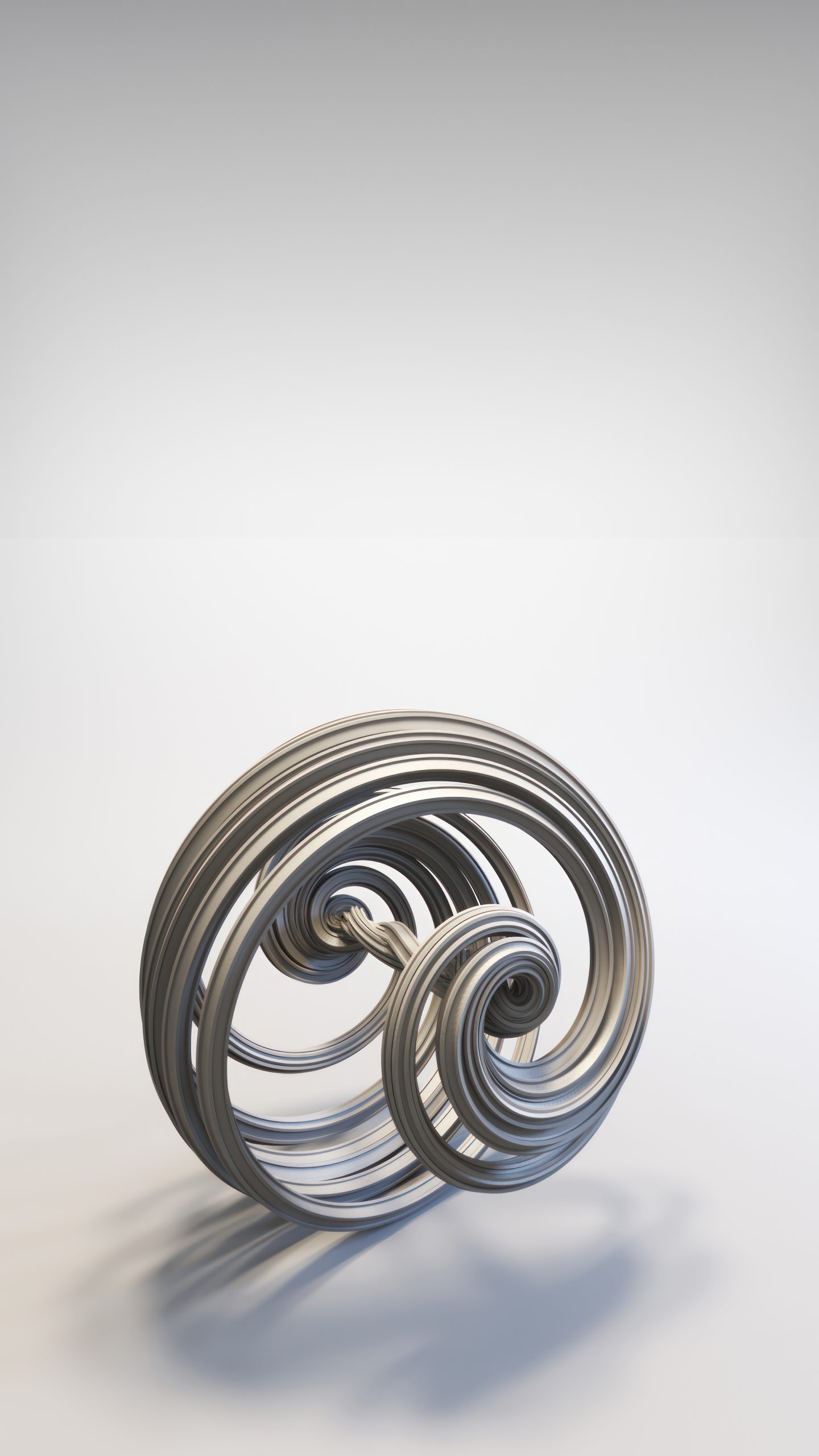
A portrait-format digital sculpture inspired by the Aizawa system, connecting nonlinear dynamics with a quiet, material sense of form.
The mathematical reference
The Aizawa system is a named model in the study of nonlinear dynamics. The title locates the artwork within that mathematical conversation, while the image remains an original sculptural interpretation. It is not a measurement or a scientific plot, and no particular parameter set is implied by the artwork.
Aizawa System equations
The first two equations couple rotation with z-dependent expansion or contraction. Higher-order terms in the third equation regulate the path.
Here, t is time and the variables are coordinates in the system’s state space. Letters such as a, b and c denote fixed coefficients. These are reference equations for the named model or family, not a recovered record of the parameters, initial conditions or integration settings used in this particular image. Chaotic behaviour depends on those choices.
Formula reference: View the documented system and source.
From a trajectory to Aizawa System art
Riccardo develops the rail in Grasshopper for Rhinoceros using Chimpanzee. The system evolves over time, producing successive three-dimensional points. Connecting those samples creates a path. A cross-section is then swept along that rail, giving the line thickness and a surface. This is how a time-dependent mathematical trajectory becomes visible as sculptural geometry.
The sweep adds a visual layer to the mathematics: its width and orientation affect how the form catches light. Riccardo then uses 3ds Max to develop the material, camera and illumination. The finished work is a digital render of this geometry, rather than a photograph of a fabricated object. No generative AI is used to create the artwork.
To read the image, follow a single edge as it moves through light and shadow. Notice where the projected path overlaps, opens or disappears behind another surface. The rail comes from a rule evolving through time; the artist’s composition lets us experience that motion as a still image. The aim is to reveal the hidden beauty of chaos theory.
A study in form
The image shifts attention from equations to an imagined object in space. Its vertical framing lets the shape feel isolated and self-contained, while the metallic rendering suggests a surface that could be encountered from different sides. This translation asks how mathematical ideas might prompt a visual form while preserving the distinction between art and scientific explanation.
Created by Riccardo Zerbinati through parametric modelling in Rhinoceros and rendered in 3ds Max, the work belongs to a collection of 40 vertical digital artworks created without generative AI.
Enquire about this artwork
Availability, edition and format can be discussed individually. Send an enquiry to ask about this study; no price or edition is listed until confirmed.