
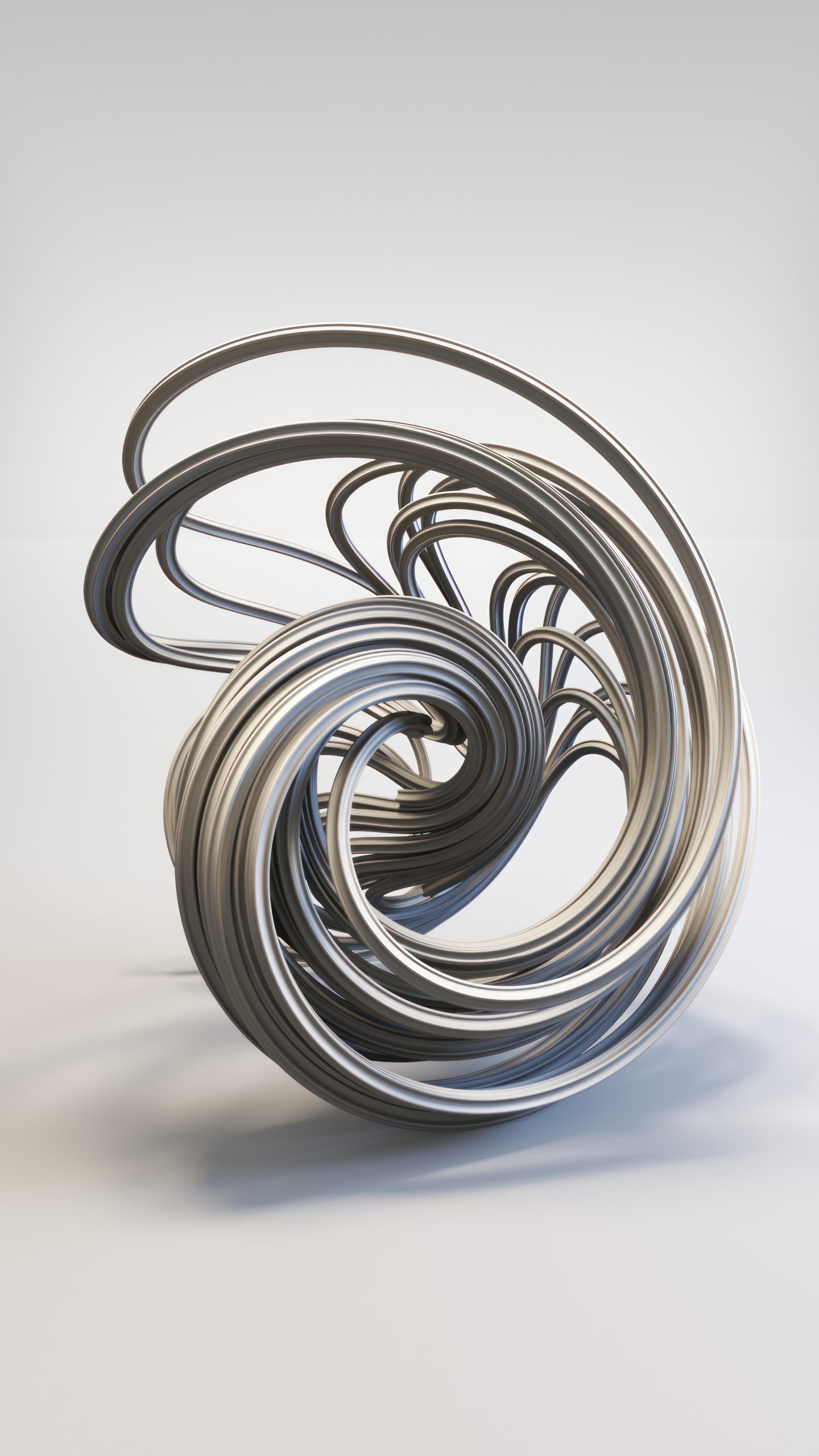
01 / Strange Attractors · Hadley System
Hadley System
A mathematical system becomes a sculptural image: an exploration of order, motion and form in parametric 3D art.
The Hadley System begins this collection with a name associated with large-scale circulation, approached here through the visual language of a strange attractor. Its scientific context is a point of departure for form, not a claim that this artwork is a weather simulation. Riccardo Zerbinati translates mathematical motion into a self-contained digital composition.
Rather than presenting a plotted diagram, this study asks what changes when motion is treated as material. The geometry is considered through depth, camera, surface and light, so that a mathematical trace can be experienced as an image. The result keeps a sense of structure while leaving room for interpretation.
Enquire about this artwork ↗Explore all 40 studiesHadley System equations
The quadratic terms couple three evolving coordinates. Rather than drawing a static pattern, the model supplies a path that changes with time.
Here, t is time and the variables are coordinates in the system’s state space. Letters such as a, b and c denote fixed coefficients. These are reference equations for the named model or family, not a recovered record of the parameters, initial conditions or integration settings used in this particular image. Chaotic behaviour depends on those choices.
Formula reference: View the documented system and source.
From a trajectory to Hadley System art
Riccardo develops the rail in Grasshopper for Rhinoceros using Chimpanzee. The system evolves over time, producing successive three-dimensional points. Connecting those samples creates a path. A cross-section is then swept along that rail, giving the line thickness and a surface. This is how a time-dependent mathematical trajectory becomes visible as sculptural geometry.
The sweep adds a visual layer to the mathematics: its width and orientation affect how the form catches light. Riccardo then uses 3ds Max to develop the material, camera and illumination. The finished work is a digital render of this geometry, rather than a photograph of a fabricated object. No generative AI is used to create the artwork.
To read the image, follow a single edge as it moves through light and shadow. Notice where the projected path overlaps, opens or disappears behind another surface. The rail comes from a rule evolving through time; the artist’s composition lets us experience that motion as a still image. The aim is to reveal the hidden beauty of chaos theory.
A closer look
Mathematics → Geometry → Light
Rules that open into form
An attractor is a structure toward which a system’s trajectories can remain confined. Chaos does not mean pure randomness: the motion follows defined rules, while sensitivity to initial conditions makes its long-term path difficult to predict. That tension—rule-bound yet open-ended—sits at the centre of this work.
In the Hidden Equations process, the system is a starting point for visual research. Parametric exploration in Rhinoceros makes it possible to study the trace as three-dimensional geometry. Materials, composition and lighting are then refined in 3ds Max. The final image is an authored interpretation of mathematical form, not an AI-generated image or a literal scientific plot.
Hadley System is Study 01 in a series of forty explorations. It can be viewed alongside the other attractors to compare how different systems suggest different visual possibilities.
Collect · Prints · Exhibitions
Interested in this study?
Ask Riccardo about current availability, print formats, dimensions and pricing. Each option is confirmed individually before any purchase.
Start an artwork enquiry ↗