
Nosé-Hoover System
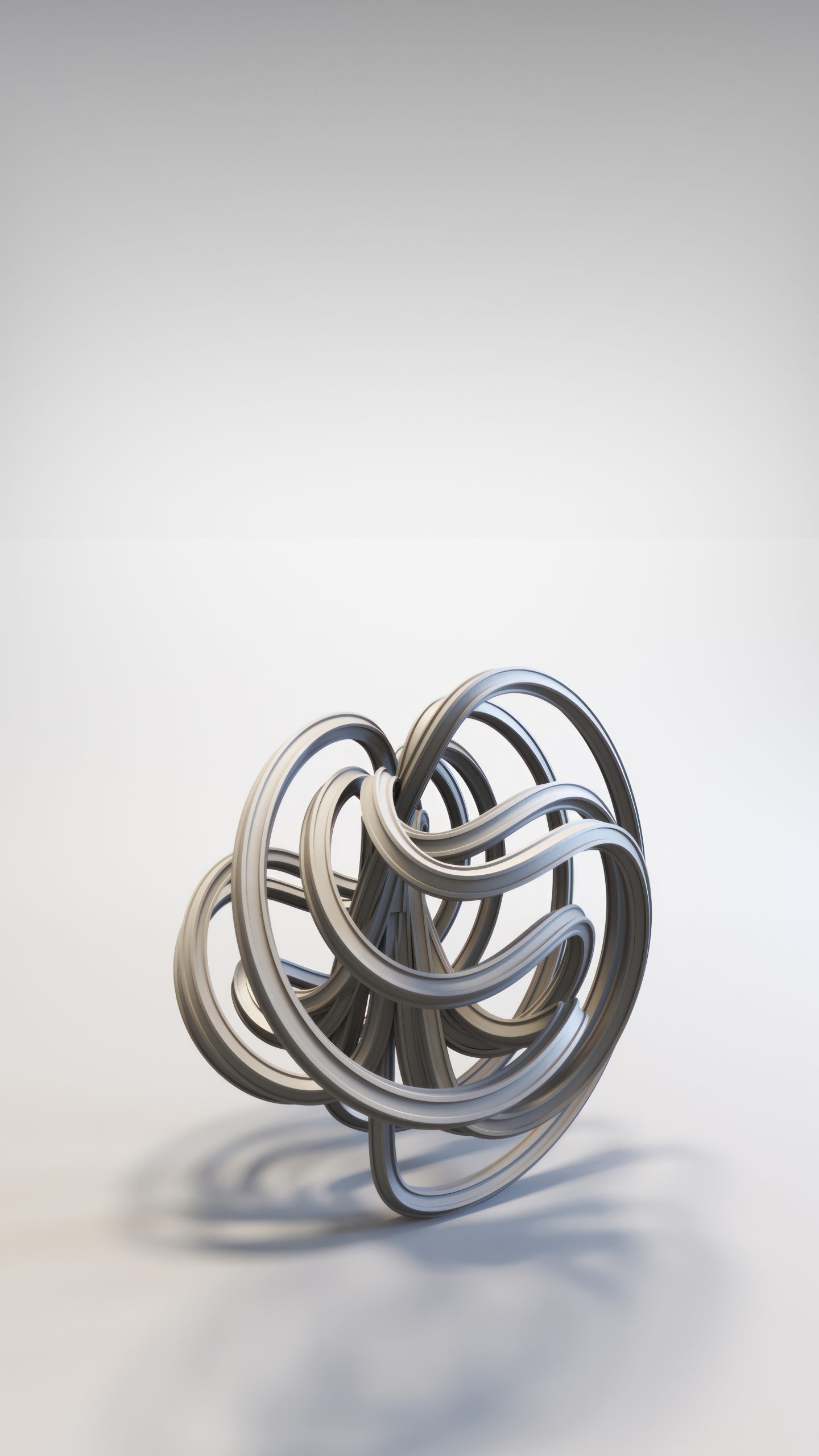
Nosé-Hoover System art by Riccardo Zerbinati brings a nonlinear model into a sculptural context. The reference equations below couple three evolving coordinates. In the artistic workflow, successive points form a rail for a swept cross-section, and the resulting surface becomes a composition of geometry, material and light.
The mathematical reference
The Nosé–Hoover thermostat belongs to molecular dynamics: it is a method used to represent constant-temperature conditions in simulations. Shuichi Nosé’s 1984 paper gives a unified formulation of constant-temperature molecular-dynamics methods. This artwork takes its name from that scientific context but does not depict a molecular simulation or measured physical data.
Further reading: Shuichi Nosé, “A unified formulation of the constant temperature molecular dynamics methods” (1984).
Nosé-Hoover System equations
This sign convention uses z as the thermostat variable. Reversing that coordinate gives the alternative convention often printed for the Nosé–Hoover oscillator.
Here, t is time and the variables are coordinates in the system’s state space. Letters such as a, b and c denote fixed coefficients. These are reference equations for the named model or family, not a recovered record of the parameters, initial conditions or integration settings used in this particular image. Chaotic behaviour depends on those choices.
Formula reference: View the documented system and source.
From a trajectory to Nosé-Hoover System art
Riccardo develops the rail in Grasshopper for Rhinoceros using Chimpanzee. The system evolves over time, producing successive three-dimensional points. Connecting those samples creates a path. A cross-section is then swept along that rail, giving the line thickness and a surface. This is how a time-dependent mathematical trajectory becomes visible as sculptural geometry.
The sweep adds a visual layer to the mathematics: its width and orientation affect how the form catches light. Riccardo then uses 3ds Max to develop the material, camera and illumination. The finished work is a digital render of this geometry, rather than a photograph of a fabricated object. No generative AI is used to create the artwork.
To read the image, follow a single edge as it moves through light and shadow. Notice where the projected path overlaps, opens or disappears behind another surface. The rail comes from a rule evolving through time; the artist’s composition lets us experience that motion as a still image. The aim is to reveal the hidden beauty of chaos theory.
A study in form
The work translates a mathematical reference associated with simulation and physical modelling into a sculptural image. Its portrait format encourages a close reading of contour and surface, while its reflective rendering gives the digital object a sense of material presence. The connection to its scientific name is a point of departure for looking, not a claim that the artwork recreates the underlying method.
Modelled parametrically in Rhinoceros and rendered in 3ds Max by Riccardo Zerbinati, this study belongs to a collection of 40 vertical works made without generative AI.
Enquire about this artwork
Availability, edition and format can be discussed individually. Send an enquiry to ask about this study; no price or edition is listed until confirmed.