
Study 34 · Strange Attractors
Sakarya System
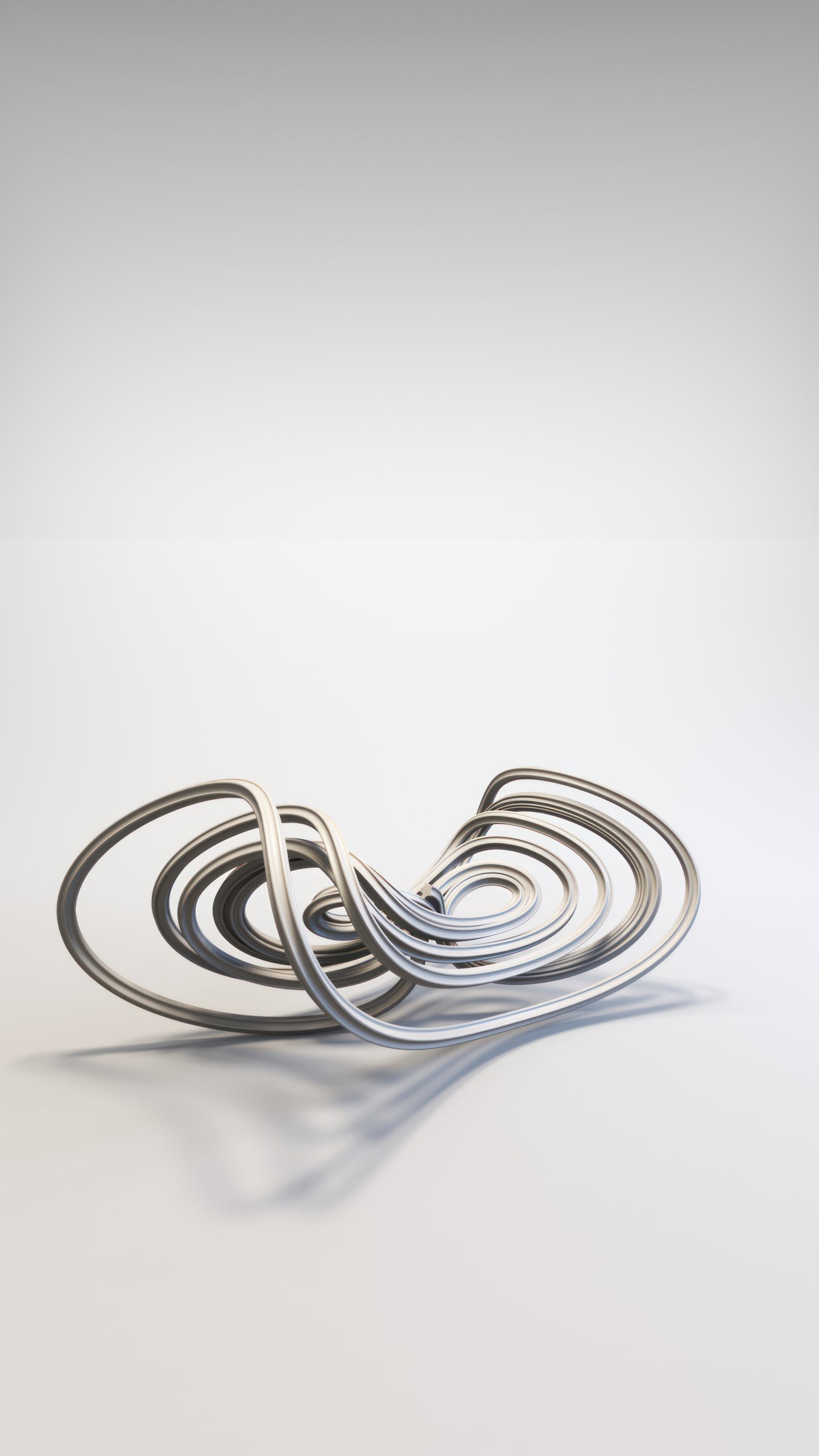
A vertical digital sculpture inspired by the Sakarya system, adding another distinct form to the Strange Attractors collection.
The mathematical reference
Sakarya is the system designation associated with this study. It provides a named mathematical starting point within the collection’s exploration of nonlinear forms. The artwork itself is not presented as data, a graph or an exact simulation; its purpose is to make a separate visual interpretation available to viewers.
Sakarya System equations
This is a simplified reference formulation of the four-scroll stellate system. The yz, xz and xy terms couple every pair of coordinates.
Here, t is time and the variables are coordinates in the system’s state space. Letters such as a, b and c denote fixed coefficients. These are reference equations for the named model or family, not a recovered record of the parameters, initial conditions or integration settings used in this particular image. Chaotic behaviour depends on those choices.
Formula reference: View the documented system and source.
From a trajectory to Sakarya System art
Riccardo develops the rail in Grasshopper for Rhinoceros using Chimpanzee. The system evolves over time, producing successive three-dimensional points. Connecting those samples creates a path. A cross-section is then swept along that rail, giving the line thickness and a surface. This is how a time-dependent mathematical trajectory becomes visible as sculptural geometry.
The sweep adds a visual layer to the mathematics: its width and orientation affect how the form catches light. Riccardo then uses 3ds Max to develop the material, camera and illumination. The finished work is a digital render of this geometry, rather than a photograph of a fabricated object. No generative AI is used to create the artwork.
To read the image, follow a single edge as it moves through light and shadow. Notice where the projected path overlaps, opens or disappears behind another surface. The rail comes from a rule evolving through time; the artist’s composition lets us experience that motion as a still image. The aim is to reveal the hidden beauty of chaos theory.
A study in form
The portrait image isolates the sculpture against a quiet background, allowing attention to settle on the contour and the reflective surface. The work can be read through its mathematical title or approached more directly as a rendered object. That dual entry point—technical reference and visual experience—runs through the wider collection.
Modelled parametrically in Rhinoceros and rendered in 3ds Max by Riccardo Zerbinati, this is one of 40 vertical digital artworks in a human-led collection created without generative AI.
Enquire about this artwork
Availability, edition and format can be discussed individually. Send an enquiry to ask about this study; no price or edition is listed until confirmed.